Translate color codes and check the actual color pair
A brand color arrives as HEX while an application asks for RGB, or a design needs a lighter perceptual variant.

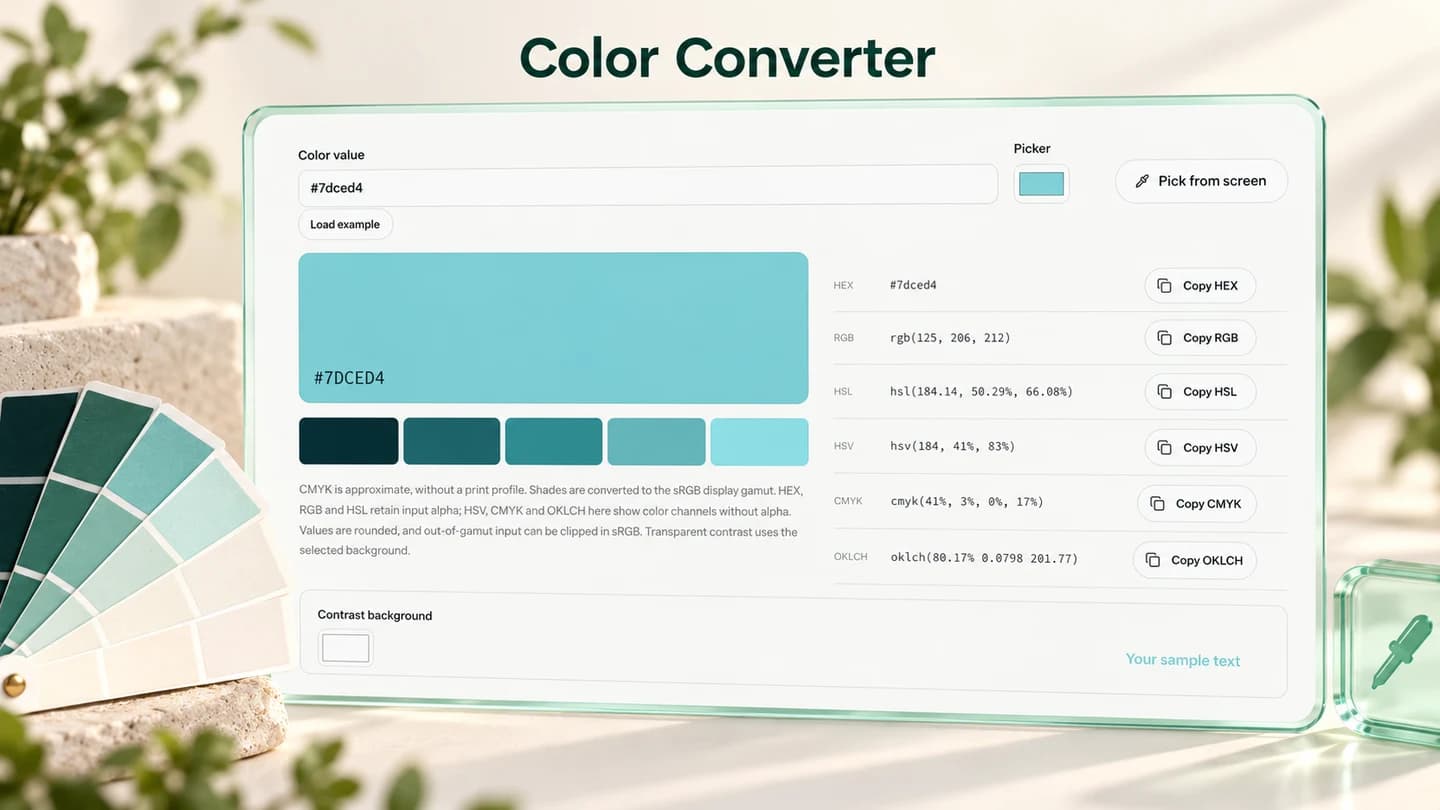
A brand color arrives as HEX while an application asks for RGB, or a design needs a lighter perceptual variant. Converting the code is only part of the job. You also need to know which color model you are using and what background will sit behind it.
This guide uses Klyvero Tools Color Converter for a focused workflow: translate color codes and check the actual color pair. The aim is a result you can inspect and use with confidence, while keeping the source available for corrections.
Open the tool to follow this Color Converter workflow in your browser.
Check the receiving system’s representation rules
Before generating or converting a value, identify the form the receiving application expects. A value can be valid in one representation and rejected in another. Keep units, separators, capitalization and any required prefix with your notes so the result remains understandable after it leaves the browser.
Use a public or invented sample to learn the controls before working with a real workflow. Save the relevant settings alongside the result when reproducibility matters. Compare the output with the receiving system’s documented rules, then test a small example there. A successful local operation establishes only what this tool did; it does not prove that another application will interpret the result as you intend.
Choose settings for the task
HEX and RGB describe the same sRGB channels. HSL and HSV provide hue-based controls, while OKLCH supports perceptual adjustments. The tool’s CMYK conversion is a mathematical approximation without a printer profile. Use a color-managed print workflow when the final output depends on a specific press or printer.
Use Color Converter step by step
- Enter the known color code and inspect the swatch.
- Choose or copy the required output representation.
- Set the intended contrast background, including transparency effects.
- Review the displayed contrast result for the actual color pair.
- Test the copied value in the final design.
Work through a small representative input before applying the operation more broadly. Keep track of the settings you chose so an unexpected result can be reproduced and corrected.
A practical example
The color #7DCED4 corresponds to rgb(125, 206, 212). That does not by itself tell you which text color will be readable on it. Set the actual foreground and background pair and check contrast. If an input has transparency, the effective displayed color depends on the background it is composited over.
Understand the limitations
Approximate CMYK is not an ICC-profiled production print conversion. The eyedropper appears only in compatible browsers and secure contexts, so manual code input remains useful when screen picking is unavailable.
Keep the result only as long as your workflow needs it and store any value that must be recoverable in your normal system of record. A generated value or converted payload is not a backup strategy. Recheck the receiving application after pasting, because extra spaces or a missing prefix can change how it is interpreted.
Review the result before using it
Copy the code in the format the receiving design system expects. Inspect the result in the interface rather than judging a swatch alone. A passing contrast ratio checks a chosen pair against text thresholds; keyboard access, labels, text size and focus behavior still need their own review.
The live tool describes local browser processing. Processing assets may still need to download before the operation can run. Save the finished output before clearing the tool or leaving the tab, and confirm that the copy you use is the reviewed result.
Frequently asked questions
Are HEX and RGB different colors?
They can express exactly the same sRGB channels. A different notation does not create a new color.
How should I validate the output?
Check its representation and meaning in the application that will consume it. Retain the settings, source and any unit information needed to understand the result; generation or conversion alone does not validate another system’s rules.
Does a completed operation mean the result is ready to share?
Open or inspect the saved output first. Confirm the settings, selected content and destination requirements, and keep the source until the reviewed copy works as intended.
Useful next steps
- Password Generator: A related generators workflow when your next task needs it.
- Explore Klyvero Labs products: Browse our apps and browser tools.
Ready to try this workflow? Open Color Converter, start with a representative input and review the saved result. Try the tool free.
Back to all articles