Add useful PDF page numbers without covering the content
A long handout is easier to discuss when everyone can refer to the same page number.

A long handout is easier to discuss when everyone can refer to the same page number. Adding numbers is useful when the source has none, but a second overlay can confuse readers if printed numbers already exist. Inspect the document before choosing a position.
This guide uses Klyvero Tools Add Page Numbers for a focused workflow: add useful PDF page numbers without covering the content. The aim is a result you can inspect and use with confidence, while keeping the source available for corrections.
Open the tool to follow this Add Page Numbers workflow in your browser.
Identify pages by their original positions
Keep the original PDF and make a note of the pages involved in your task. A viewer’s page position can differ from the number printed inside the document because a cover or introduction comes first. When a control accepts page ranges, use the original positions expected by that control and check the first affected thumbnail.
Use a small representative section when exploring a new operation. Include a normal text page and a page with a diagram or scan if the document has both. A successful first page does not establish that every page has the same structure. After exporting, check the final page as well, because a missing appendix or unintended range can be easy to overlook.
Choose settings for the task
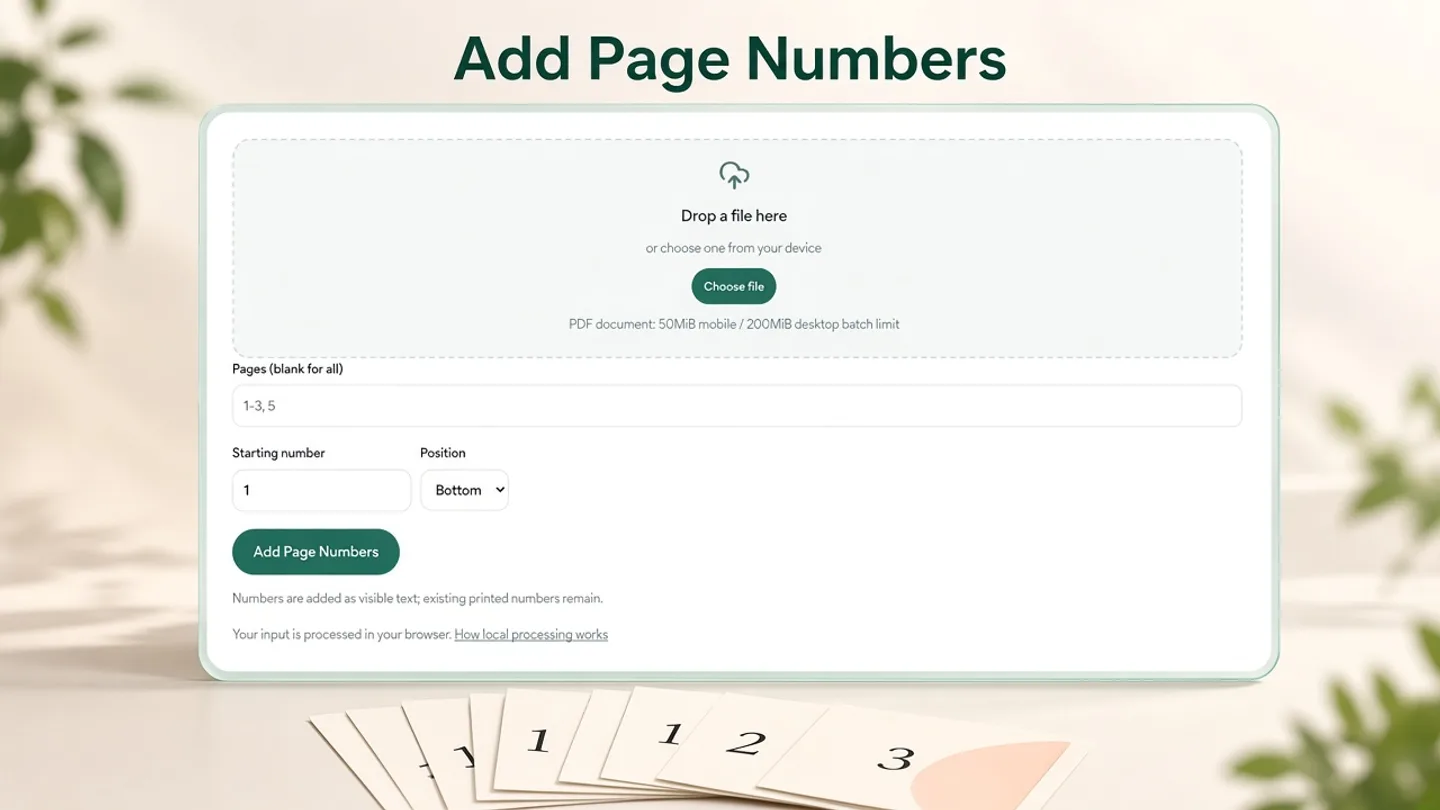
Set the starting number, its position and any optional page range. The numbers are added as visible text. They do not replace printed numbers already present on the pages. Decide whether a cover should be numbered and whether the new labels should correspond to an external agenda or submission checklist.
Use Add Page Numbers step by step
- Open the PDF and inspect existing header/footer content.
- Choose the starting number and placement.
- Set a range if only part of the document should be numbered.
- Create the numbered copy.
- Inspect for overlap and confirm the visible sequence.
Work through a small representative input before applying the operation more broadly. Keep track of the settings you chose so an unexpected result can be reproduced and corrected.
A practical example
For an unnumbered report, start at one and place the numbers in the bottom center where the footer has space. Check a page with a large diagram and one with a long footnote. A position that is clear on the first page may overlap content later in the document.
Understand the limitations
The operation adds text rather than editing the existing document’s numbering system. Existing page labels, cross-references and printed numbers may remain different from the new visible sequence.
A rewritten PDF can behave differently from the original at the document level. If signatures, forms, bookmarks or other interactive features matter, check them separately in a suitable viewer rather than assuming that intact page thumbnails prove everything survived. Keep signed originals when signature validity matters.
Review the result before using it
Reopen the output and inspect the beginning, middle and end. Check that the numbering starts at the intended value and remains readable. If the document already contains chapter page labels, explain the new reference system to readers instead of pretending that the visible overlays update internal references.
The live tool describes local browser processing. Processing assets may still need to download before the operation can run. Save the finished output before clearing the tool or leaving the tab, and confirm that the copy you use is the reviewed result.
Frequently asked questions
Does this replace old printed numbers?
No. It adds a new overlay. Choose a clear position or prepare a source document without conflicting numbers.
Do I still need the original PDF?
Yes. Keep it for comparison and for any document features needed later. A downloaded copy is a separate result, and a change that solves one task may not preserve every behavior of the source.
Does a completed operation mean the result is ready to share?
Open or inspect the saved output first. Confirm the settings, selected content and destination requirements, and keep the source until the reviewed copy works as intended.
Useful next steps
- Merge PDF: A related pdf workflow when your next task needs it.
- Image to PDF: A related pdf workflow when your next task needs it.
- Explore Klyvero Labs products: Browse our apps and browser tools.
Ready to try this workflow? Open Add Page Numbers, start with a representative input and review the saved result. Try the tool free.
Back to all articles